
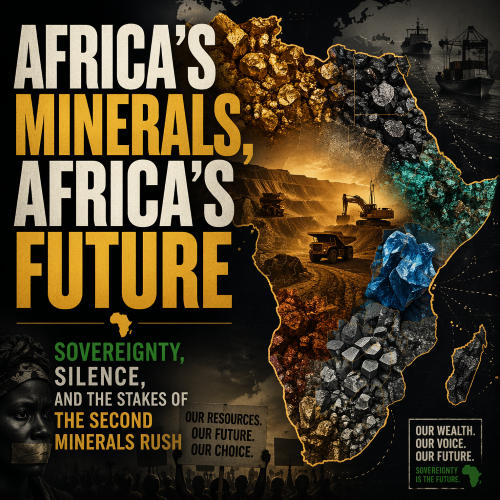
Africa's Minerals, Africa's Future: Sovereignty, Silence, and the Stakes of the Second Minerals Rush
A reflection from AFRODAD's side session at the Alternative Mining Indaba, Cape Town, February 2026
Introduction
Africa sits at a crossroads as the world transitions towards clean energy. The continent has an estimated 30 % of the world’s mineral reserves. Zimbabwe and DRC have lithium, Zambia and Congo have cobalt, South Africa has manganese, Guinea has bauxite, and all over Africa, vast mineral deposits are scattered. These are the sinews of the global energy transition. These commodities are at the centre of electric vehicle revolution, wind turbines, solar panels and battery production. However, a critical question remains unanswered, and it was asked at the AFRODAD side session this year's Alternative Mining Indaba (AMI); who owns Africa’s mineral resources? The answer, too often, is not Africa.
The following article draws on the discussions that were had at the recent AMI in Cape town at AFRODAD’s side session "Who Owns Africa's Minerals? Beneficial Ownership, Transparency, and Accountability in the Mining Sector." The article explores five interlocking mineral resource governance challenges. These are the critical minerals imperative; the state of the Africa Mining Vision (AMV) and its supporting frameworks; the ideological and structural deadlock playing out in global climate negotiations; the geopolitical fractures reshaping Africa's room to manoeuvre; and the debt and development nexus that binds, and burdens, the continent's sovereign choices.
I. The Critical Minerals Imperative: A New Rush, Old Wounds
The language of opportunity surrounding Africa’s minerals is intoxicating. To achieve the clean energy transition, the International Energy Agency estimates this will require a sixfold increase in mineral output by 2040. Africa is poised to supply the bulk of that mineral output to meet that demand. The DR Congo accounts for over 70% of global cobalt supply, whilst Zimbabwe is the fourth-largest lithium reserve illustrating that Africa has the resources to drive the clean energy transition and must extract value from that. However, the echoes of history show us this cannot be taken at face value. This has now been touted as a second mineral rush, and it risks replicating the exploitative and extractive architecture of the first. The first mineral rush was characterised by the establishment of extractive on dependent economies, unclear beneficial ownership structures, illicit financial flows and communities left bearing the costs such as land dispossession and water contamination.
Africa already has the blueprint towards the second mineral rush through the African Union’s Critical Minerals Strategy and the Africa Mining Vision. They situate mineral governance within the broader architecture of Agenda 2063, calling for value addition, industrial linkages and use of minerals as engines for economic transformation. The challenge is the gap between these ambitious documents and the reality on the ground. At the AFRODAD side session at AMI on February 10, 2026, Gloria Majiga from Tax Justice Network Africa (TJNA), Keith Muhati from All Africa Conference of Churches and Lucy Shao from Hakirasilimali did not mince their words on the opaque ownership structures. In numerous African countries the beneficial owners in mining licenses are often shielded behind shell companies and cross boarder corporate structure that make it had for tax authorities to collect revenue well. Through this pipeline, Africa’s mineral wealth continues to haemorrhage.
II. The Africa Mining Vision: A Framework in Search of Political Will
The Africa Mining Vision adopted by the AU Assembly in 2009 is the core framework for transformative mineral governance in Africa. It calls for sustainable growth and socio-economic development underpinned by transparent, equitable and optimal exploitation of Africa’s mineral resource. It envisions a continent that creates value from its resources, generates significant revenue, build human capital in mining communities and transform the social condition of the everyday African. And yet, to borrow from the characterisation offered at the side session, the AMV is a shelved document. Among the AU Member states, only Guinea, Mali, Zambia, and Nigeria have officially ratified the statute associated with the AMV which is the African Minerals Development Centre (AMDC). Countries continue to negotiate biliteral deals with mining investors, constraining the buy-in to the AMV. This resource nationalisation constitutes half the problem for the failure to adopt the AMV by AU member states. The other half is due to that fact that the AMV and its supporting instruments remain poorly understood outside the civil society and technocratic circles. Therefore, even if the political will is to be found, there is still work to be done to explain what it entails. The AMV cannot be ratified by governments who do not understand it and supported by people who have never encountered it.
To address this challenge, the session proposed advocacy beyond the traditional sense but to deliberately build knowledge among targeted constituencies. This can be done through actors like faith-based organisations, university clubs and social media campaigns to convey the message to spaces where civil society and think tanks have not traditionally reached. There is need for the message to escape the echo chamber. It also needs to be explained from an angle of domestic resource mobilisation as a critical and emancipatory lever for climate finance. The AMV has sections that speak to the fiscal dimension of resource governance; however, these sections remain unknown. Therefore, to popularise AMV as a climate finance instrument becomes a key part to secure political will for AMV adoption.
III. The Ideological Deadlock: Between the Mining Indaba and the Alternative
There is also a longstanding ideological deadlock between the Mining Indaba and the Alternative Mining Indaba. The two events are also separated by funding and worldview as the former draws the mining industry’s corporate elite government ministers and business forums. The latter is a convening of civil society, academics and affected persons. One serves as a market while the other serves as a forum. That these two events exist in parallel is a symptom of the problem of the ideological gulf at hand. Even though these two events happen in the same city and have the same content in essence, they are not well aligned in terms of sharing the same spirit. The constraint has always been how community and civil society requests can be put forward into the Mining Indaba and how the platform can be utilized to hold corporates and government accountable.
At the Mining Indaba the position is essentially that of Donald Trump’s “drill baby drill” transposed into an African context. This position is guided by the idea that fossil fuels remain essential to Africa’s energy security and development. As Gwede Mantashe put it at the African Energy Week, “In recognition of the continued role of fossil fuels in supporting energy security and the fact that 82% of energy sources in the world are from these fossil fuels, Africa must intensify its efforts aimed at developing its oil and gas sector in order to benefit from the expected increase of the natural gas market in global supply.” To cement this position further is the logic that a continent with deep energy poverty cannot be expected to voluntarily abandon its assets in the ground. This then transfers the cost to the communities who then bear the brunt of climate disasters and with little adaptive mechanisms.
On the other hand, the Alternative Mining Indaba operates from a moral register to “keep it in the ground”, a position continued to be advocated for at the Indaba. This is an argument rooted in the distribution of costs as communities bear the huge brunt of costs that do not appear in the company accounts or government revenue statements. Research on extractives in Africa shows that these costs are often reflected in loss of livelihoods, land degradation, environmental destruction and harm to health. The contamination of water sources, the loss of arable land, the health complications because of dust, the violence and labour exploitation is always borne by the communities. These invisible costs are never discussed at the Mining Indaba thereby creating an ideological gulf between the two gatherings. Hence, the elephant in the room is how these concerns can move beyond the rooms of the Alternative Mining Indaba and be heard in the Mining Indaba itself. This is a microcosm of the dilemma which Africa finds itself in.
IV. The Geopolitical Storm: Sovereignty Under Pressure
The geopolitical dimension of minerals is becoming increasingly central. This situation can be seen in the recent war in the Middle East, where the global energy crisis has become more pronounced and has placed greater pressure on African countries to increase mineral extraction and drill for export. This in turn has a ripple effect on ordinary citizens, who bear the burden through fuel-based price hikes and a higher cost of living. Critical minerals are not only important because of their economic value but also because of their role in securing supply chains. Over time, extraction and processing have largely been moved outside Western countries to resource-rich regions. While this may have reduced costs and environmental burdens for these countries, it has also created long-term dependencies on external sources for mineral supply.
In this context, African countries, despite having extensive mineral resources, are often positioned at the early stages of the value chain. They do not usually control supply chains, particularly in processes such as refining and manufacturing. This limits the extent to which they can exercise full sovereignty over their resources. For instance, in the case of cobalt, a significant share is extracted in the Democratic Republic of Congo but processed in China. In this specific case, Chinese-owned companies own 17 cobalt mines in the country. We can deduce that this reflects a broader pattern where extraction takes place in Africa while value addition and control are largely retained outside the continent.
The global competition of minerals in Africa increasingly puts pressure on the continent. With such an increasing demand for minerals, Overall, the continent has at least a fifth of the world’s reserves of a dozen minerals that are critical for the energy transition. To meet the expected rise in global demand, production of minerals and metals such as lithium, graphite and cobalt will need to increase by nearly 500% by 2050. Africa is at a point where resources are extracted heavily. In this process, although Africa owns the resources, the processing and benefits from it is controlled by others. This has limited its sovereignty.
The African Mining Vision is one of the most important instruments that ensure that such mineral resources are managed in a transparent and equitable way so that they contribute to sustainable development in Africa. It also emphasizes the need to move beyond exporting raw materials by strengthening local industries. Although this is a commendable effort, the geopolitical state makes it difficult to implement it fully in practice.
V. The Debt and Development Nexus: The Price of the Transition
Africa’s ability to benefit from its mineral resources is also affected by the high levels of debt across many countries. Financial pressure plays a major role in limiting these benefits. Because many countries are heavily indebted, it becomes difficult to focus on long-term development. As a result, there is often a need to generate revenue quickly. Mineral extraction becomes one of the main ways countries try to manage these financial constraints. In some cases, loan arrangements are tied to mineral resources, where future extraction is used as a form of repayment. However, this means that countries do not fully benefit from the revenue generated by their own resources.
In addition to this, many countries cannot fully capture the revenue generated from their mineral resources. Weak systems of domestic resource mobilisation mean that a portion of this income is lost through issues such as tax avoidance, illicit financial flows, and limited oversight. This further weakens the link between mineral wealth and development outcomes. It also reinforces the relevance of calls for a UN Tax Convention, which could help strengthen sovereign taxing rights and advance fairer global tax rules for developing countries. At the same time, Africa is expected to play a central role in supplying the minerals needed for the global energy transition, yet it does not receive sufficient financial support to do so. This creates an imbalance where the continent contributes significantly to the transition but carries a disproportionate share of the burden, making it even more difficult to use its resources in a strategic and sustainable way. Therefore, the AMI’s vision and intention to utilize minerals for long-term development will undergo significant challenges.
VI. The Role of Faith Actors: Moral Authority in the Mineral Conversation
Faith-based actors play an important role in how mineral governance is discussed, even though they are not directly involved in decision-making. They bring a different perspective that focuses more on ethical responsibility and how resources are managed. In many cases, discussions around minerals tend to focus on economic value and investment, while issues such as accountability and transparency receive less attention. Faith actors help shift this by raising concerns about how resources are used and whether they are benefiting the broader population. Their involvement brings more attention to governance issues that are often overlooked.
At the same time, faith actors also highlight how decisions around mineral resources affect communities on the ground. They draw attention to the fact that these decisions are not just technical or economic but have real impacts on people’s lives. This includes issues related to inequality, access to services and the broader social consequences of extraction. Through advocacy and community engagement, they help bring these concerns into wider discussions and policy spaces. In this way, they contribute to a more inclusive conversation by ensuring that the voices of affected communities are not completely left out.
Conclusion
Africa's mineral wealth is, at once, its greatest opportunity and its most enduring vulnerability. As the world moves towards a clean energy future, the continent finds itself at the centre of a global scramble that carries echoes of the past. The critical minerals demand is urgent, and Africa has what the world needs. The sentiments coming out of AMI 2026 is that a resource has never, by itself, guaranteed prosperity. Therefore, there is need for political will, to translate the wealth in the ground to solve the poverty above it. The side session explored five interlocking challenges, and they were also covered in this article. The Africa Mining Vision is a sound and transformative framework. However, it remains a shelved aspiration, undermined by low political will, poor domestication and limited public awareness. The ideological gulf between the Mining Indaba and its alternative counterpart reflects a deeper failure to reconcile the economic imperatives of extraction with the lived realities of communities who bear the costs. The geopolitical contest over critical minerals continue to position Africa at the bottom of the value chain. Africa supply’s the raw materials while others capture the wealth generated by processing and manufacturing. Debt burdens further constrain sovereign choices, pushing governments towards short-term extraction deals rather than long-term development strategies. And through all of this, illicit financial flows and opaque beneficial ownership structures continue to drain the revenue that should be building hospitals, schools and industries.
Yet, there is still hope and reason for optimism. The Africa Mining Vision offers a credible path forward if communicated clearly. It reframes mineral governance as a key instrument of climate finance and domestic resource mobilisation. Faith-based actors, community organisations, university platforms and non-traditional advocacy spaces represent an untapped constituency capable of generating the popular pressure that political will ultimately requires. The conversation must escape its echo chamber. What emerged most clearly from the AFRODAD side session at the Alternative Mining Indaba is that the question of who owns Africa's minerals is not merely a legal or technical one. It is a question of power, accountability and justice. The second minerals rush need not replicate the first. To have that outcome demands that African governments, civil society, communities and faith-based actors work in unison.
By:
Elshaday Alemayehu, Intern, International Public and Private Finance.
Obrail Tafadzwa Mavunga, Intern, Domestic Resource Mobilisation.