
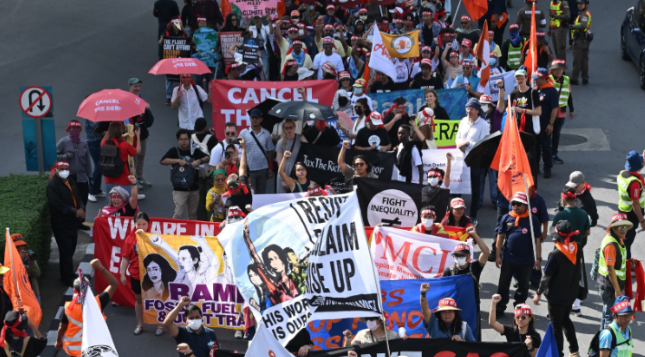
AFRODAD Joins Global Day of Action in London to Demand Debt Justice
London, 17 October 2026 — AFRODAD joined movements and civil society organisations in London for the Global Day of Action, challenging the policies of the International Monetary Fund (IMF) and the World Bank Group and calling for a fairer global financial system that puts people and development first.
The mobilisation took place as the IMF and World Bank held their annual meetings in Bangkok, Thailand, where decisions on global economic and financial policies with far-reaching implications for countries and communities worldwide were being made. Across Africa, Asia and the Pacific, Latin America, Europe and North America, civil society organisations and social movements raised their voices against financial and debt policies that place disproportionate burdens on citizens, undermine public services and constrain countries’ development choices.
For Africa and the wider Global South, the demand for debt justice is inseparable from the struggle for economic sovereignty, human rights and sustainable development. High debt-servicing obligations often limit governments’ fiscal space to invest in essential public services, social protection and other development priorities.
AFRODAD’s call for debt justice is grounded in its research advancing a fundamental shift in the global approach to sovereign debt resolution. In its study, "Moving from Creditor-Centric Debt Relief Initiatives Towards the Realisation of the UN Framework Convention on Sovereign Debt", AFRODAD examines the need for a fairer international framework that promotes shared responsibility between creditors and borrowers and addresses the limitations of existing debt relief approaches.
The study highlights the importance of a United Nations Framework Convention on Sovereign Debt, noting that it could help advance “a financial architecture that works for development and facilitates affordable and long-term financing.”
The Global Day of Action reinforces the urgency of moving beyond creditor-centred approaches towards transparent, equitable and effective international debt resolution mechanisms that prioritise people’s rights and countries’ development needs. For countries in the Global South, this means advancing debt solutions that protect development priorities, strengthen economic sovereignty and ensure that debt obligations do not come at the expense of essential public services and human rights.
AFRODAD’s participation reaffirmed its commitment to challenging structural inequalities in the global financial architecture and advancing debt governance that serves citizens. This requires more than short-term interventions; it demands fair and transparent debt resolution processes, accountability from creditors and borrowers, and reforms that enable countries to mobilise resources for sustainable, people-centred development.
The call for debt justice extends beyond a single day of mobilisation. It is a continuing demand for a global financial system that respects countries’ policy space, safeguards public resources and places human rights and development at the centre of economic decision-making.