
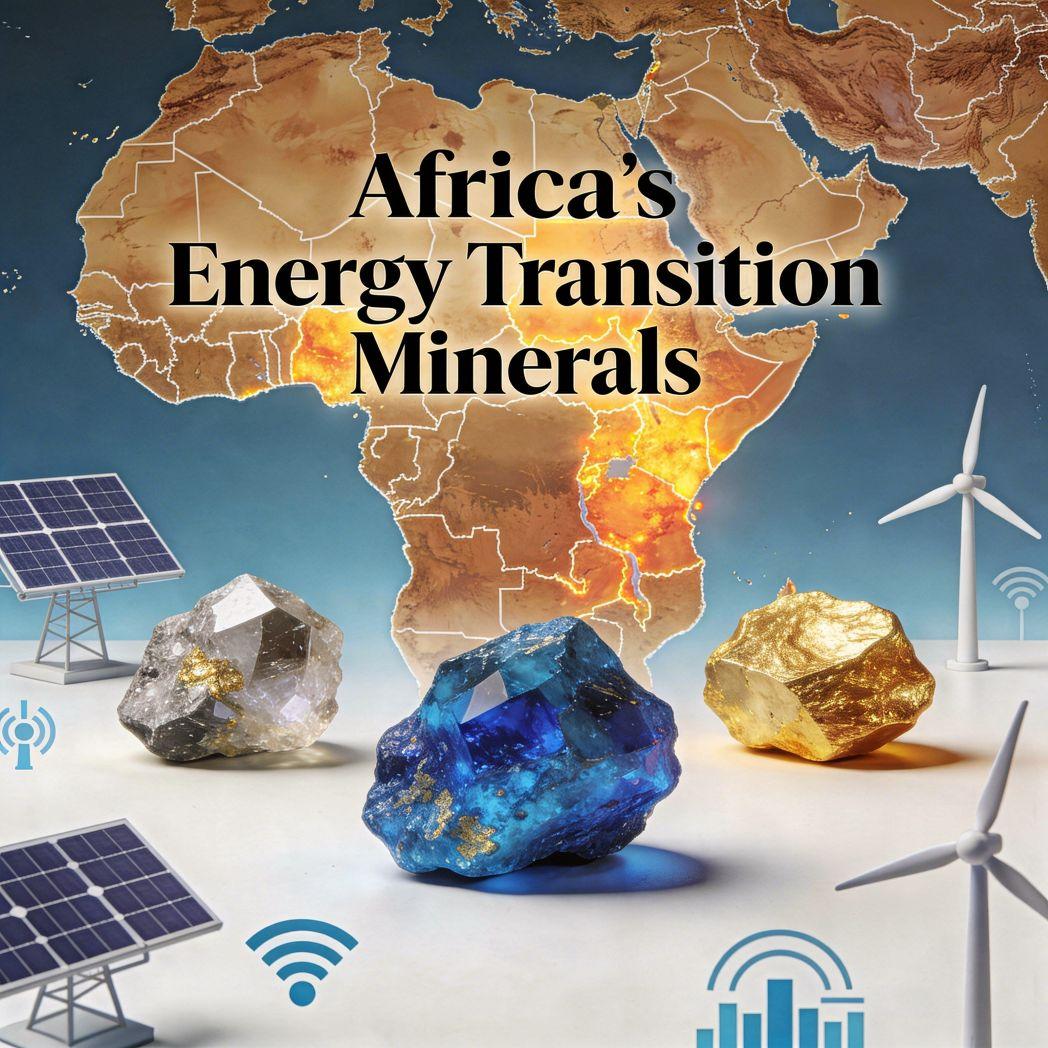
Leveraging Africa’s Energy Transition Minerals: A Roadmap for Economic Transformation and Sustainable Development
Focusing on Cobalt and Nickel
Africa is at the core of the global energy shift, as the world gravitates toward the new industrial age: the age of clean energy technologies. Reducing carbon emissions from the production and use of energy is an essential component of the global commitment to achieving the Sustainable Development Agenda, as articulated in the Africa Mining Vision. Africa has the resources and potential to benefit from a new era in energy transition, with demand for critical minerals projected to increase by almost 500% by 2050. Among the most strategically important are cobalt and nickel, two minerals essential for manufacturing high-performance batteries. With vast deposits across the continent, the Democratic Republic of the Congo alone accounts for more than 70% of world cobalt output, with Madagascar, Tanzania, and Zimbabwe all contributing substantially. Africa holds a unique opportunity to transform its mineral endowment into a foundation for domestic resource mobilisation and sustainable economic growth.
Cobalt and nickel play distinct yet complementary roles in powering the clean-energy revolution. Cobalt ensures the stability and longevity of lithium-ion batteries, while Nickel increases their energy density, enabling longer driving ranges in electric vehicles. Global demand for both minerals is projected to continue to rise significantly, driven by growing electric vehicle (EV) adoption and grid-scale renewable energy storage. The Democratic Republic of Congo stands in a league of its own, whose dominance in cobalt supply can influence the shape of the cobalt market. Cobalt is a very important metal, Africa’s competitive advantage is undeniable. Meanwhile, major nickel operations in Madagascar’s Ambatovy project, as well as deposits across southern Africa, place the continent in an equally strategic position.
Despite this natural wealth, Africa captures only a fraction of the value generated along the mineral supply chain. Most cobalt and nickel leave the continent as raw or minimally processed ore, while revenue leakages, illicit mineral flows, and poorly structured fiscal regimes limit governments’ ability to collect fair returns. Price volatility, resource-based loans (RBL), collateralisation which undermine revenue rents, opaque contracts, and inconsistent governance frameworks further constrain domestic resource mobilization. As a result, African countries remain vulnerable to external shocks, even as global industries profit from African minerals.
The real opportunity lies beyond exploration and extraction. To turn this mineral endowment to one that boosts domestic revenues while advancing sustainable economic transformation.
Countries must strengthen and modernize their mineral fiscal regimes. Sliding-scale royalties linked to commodity prices, reduced tax exemptions, and digitalized revenue administration can significantly increase transparency and efficiency. Digital mineral management systems are particularly powerful tools for closing leakages.
Secondly, Africa must invest in local processing and refining capacity aligning with African Minerals Development Centre and country context in implementation of the Africa Green Mineral Strategy. Transforming cobalt into battery-grade cobalt sulphate, and nickel into nickel sulphate, captures higher value and creates skilled jobs. Special Economic Zones designed for mineral beneficiation, along with the Zambia–DRC Battery Value Chain initiative, demonstrate how cross-border collaborations can support industrialization.
Thirdly, governance reforms are essential. Adopting the African Minerals Governance Framework (AMGF), enforcing responsible sourcing standards, and improving environmental and social safeguards will help African minerals meet the rising demand for ethically sourced, low-carbon inputs.
Finally, regional cooperation through the African Continental Free Trade Area (AfCFTA) can harmonise policies, prevent a race to the bottom, and strengthen Africa’s position in global negotiations. The continent can turn its mineral wealth into domestic revenue, resilient economies, and a greener future for all.
Africa’s cobalt and nickel reserves underscore the continent’s strategic role in the global energy transition. But unlocking this potential demands transparent visionary leadership choices that put Africa at the centre of its own narrative. By claiming its rightful place in the global clean-energy revolution, Africa can define the terms of engagement, set the standards, and shape the markets of tomorrow. This is the moment for Africa: Rule Maker, Not a Rule Taker.
By Malambo Gloria Kankato, Cohort 9 Intern, Executive Director's Office